


Watch Fact of the Day · November 24, 2026 · Watches And More
Inside a familiar quartz watch, a tiny motor turns an invisible rhythm into something you can see.
Watch a seconds hand hop from one marker to the next.
Tick. Tick. Tick.
It looks almost too simple to be interesting. Yet that little jump is the final act in a remarkable performance involving a vibrating crystal, electronic counting, a motor and miniature gears.
The mystery isn’t just how a quartz watch keeps time. It’s how electricity becomes moving hands.
Let’s follow the journey—with Seiko’s documented Caliber 7546A as our worked example, and a few important stops along the way.
⚡ The Battery Supplies Energy. The Crystal Supplies the Rhythm.
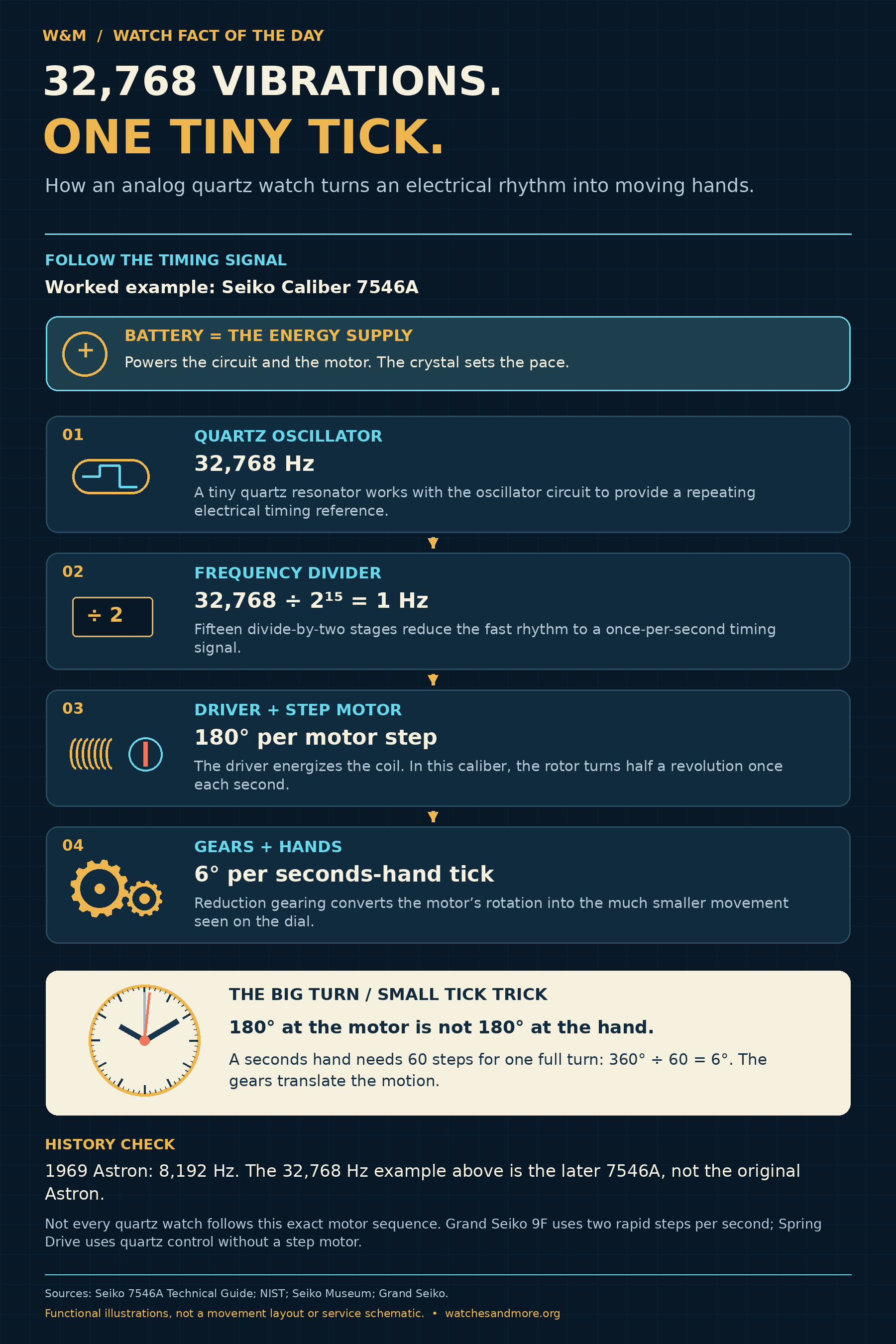
These are different jobs. A battery provides the energy needed to run the watch; the quartz oscillator provides its timing reference.
Quartz is piezoelectric: mechanical strain and electrical effects are linked in the material. In a properly designed oscillator circuit, a carefully shaped quartz resonator sustains a stable vibration. Think of a tiny, electrically maintained tuning fork, rather than a miniature engine pushing the hands.
For many quartz watches, that rhythm is 32,768 cycles per second, or 32,768 Hz. The motion is far too fast to follow with your eyes. Fortunately, the circuitry can keep count. [NIST: quartz clocks]
🧮 Why Such an Oddly Specific Number?
Because 32,768 is 2 to the power of 15.
Halve it fifteen times and you arrive at one:
32,768 → 16,384 → 8,192 → … → 2 → 1.
This is the frequency divider’s job: reduce a fast reference signal to a slower rhythm the watch can use. NIST explains that quartz timekeepers commonly divide a 32,768 Hz reference down to one-second ticks. The arithmetic is elegant; nobody inside your watch needs to shout “one Mississippi.” [NIST: how clocks work]
🔄 Where the Signal Becomes Motion
Seiko’s 7546A technical guide documents the next handoff: the circuit sends one-per-second impulses to the coil, and the step motor turns in 180-degree increments. A gear train carries that rotation to the hands.
That half-turn happens at the motor—not at the seconds hand. A seconds hand completing one revolution in sixty equal ticks advances only six degrees per tick: 360 ÷ 60 = 6. The gearing translates the movement. [Seiko 7546A Technical Guide]
🎄 A Christmas Day Revolution—with a Different Frequency
There is a historical detail worth keeping straight.
Seiko launched the Quartz Astron 35SQ on December 25, 1969, introducing the first commercially available quartz wristwatch. But its oscillator ran at 8,192 Hz, not 32,768 Hz. Seiko identifies the higher frequency with later quartz watches. [Seiko: Quartz]
The Smithsonian’s Astron example preserves an original module with a quartz oscillator, hybrid circuitry and a miniature stepping motor. Its case and band are reproductions—a useful distinction when discussing a museum object. The museum records an original retail price of 450,000 yen, roughly comparable to a Toyota Corolla. [Smithsonian]
So the technology we associate with an affordable everyday watch arrived wearing a rather expensive price tag.
💡 Did You Know? That Tick Was a Power-Saving Choice.
The Seiko Museum specifically links the Astron’s once-per-second hand movement to saving power. A visible pause could be an engineering advantage.
Miniaturization was the larger challenge. Seiko’s late-1950s quartz equipment for broadcasting was about the size of a large locker. Its path toward the wrist included tabletop timing equipment for the 1964 Tokyo Olympics and a wristwatch prototype in 1967.
Getting the crystal, circuitry and motor into something wearable was the achievement. Making the hand move was only the part the customer could see. [Seiko Museum]
⌚ Does Every Quartz Watch Work Exactly Like This?
No—the 7546A is a specific, documented example.
Grand Seiko’s 9F adds a clever twist. Its Twin Pulse Control Motor produces two rapid, consecutive steps each second. They appear to the naked eye as a single tick, while supplying the torque needed for broader, heavier hands. The visible motion alone doesn’t reveal the entire sequence underneath. [Grand Seiko: 9F]
Spring Drive takes another route. It uses quartz as a timing reference, but a mainspring drives the hands and an electromagnetic brake regulates the glide wheel. The Seiko Museum explicitly notes that it does not require the step motor used in a conventional quartz watch. Its gliding seconds hand is a reminder that quartz regulation and one-second ticking are separate ideas. [Seiko Museum: Spring Drive]
⭐ Why It Matters
Understanding this handoff makes an ordinary watch much more interesting. “Quartz” tells you something about its timing reference; it doesn’t describe every detail of its display or motor.
It also gives you better questions to ask: What sets the pace? What supplies the energy? What turns that energy into movement?
Those questions turn a label on a dial into a story you can actually follow.
❤️ The W&M Take: Give the Little Tick Some Credit
At Watches And More, we love a beautiful mechanical movement. But the unassuming quartz watch deserves its moment under the loupe, too.
There’s something wonderfully satisfying about all that activity ending in one tiny, readable step.
The crystal sets the rhythm. The circuit counts. The motor turns. The hands tell the story.
Sources & Further Reading
- Seiko: Caliber 7546A Technical Guide (functioning section, printed pp. 2–4)
- NIST: Timekeeping and Clocks FAQs
- Michael A. Lombardi / NIST: The Evolution of Time Measurement, Part 2 — Quartz Clocks
- Seiko Museum: The Birth of the Quartz Timepiece
- Seiko: Quartz — including the original Astron’s 8,192 Hz frequency
- Smithsonian: Seiko Quartz Wristwatch, object nmah_1204788
- Grand Seiko: 9F Quartz and Twin Pulse Control Motor
- Seiko Museum: Spring Drive
Disclaimer: Every effort has been made to keep these watch facts accurate, but the world of horology is full of myths, disputed stories, and fascinating trivia. Consider these facts a starting point for discovery rather than the final word. If you have corrections or additional insights, let us know—we’re always happy to keep the record ticking in the right direction.
Read Next
- Why Early Watches Had Only One Hand
- Watch Fact of the Day: The Accutron’s Tuning Fork Humming Sound of Space!
Watches And More · Watch Fact Archive · Companion site
Will you look at your quartz watch’s next tick a little differently?

