
Watch Fact of the Day · November 25, 2026 · Watches And More
Your digital watch can keep counting the seconds while its display seems to vanish. The explanation is hidden in the light.
You glance at your watch. The numbers look perfectly clear.
Then you tilt your wrist—or look through polarized sunglasses—and suddenly they become faint, strange-looking or almost impossible to see.
Has the battery surrendered? Has your trusty digital decided to take a coffee break?
Sometimes the watch is working just fine. What has changed is the way its display delivers light to your eyes.
There are two effects to untangle: viewing-angle contrast and polarization filtering. They can occur together, but they are different parts of the story.
💡 The First Surprise: The Numbers Aren’t Tiny Light Bulbs
An LCD—liquid crystal display—doesn’t generate its own light. Its liquid crystal layer controls light supplied from elsewhere.
In a reflective display, surrounding light enters the panel and reflects back toward you. A backlight or separate illumination system serves a different purpose: helping you read when ambient light is insufficient. Crystalfontz explains why reflective LCDs suit low-power, sunlight-readable products, while an unilluminated reflective display cannot be read in darkness. [Crystalfontz]
That familiar gray-green screen is doing something rather clever with the light already around it.
🔬 A Sandwich That Controls Light
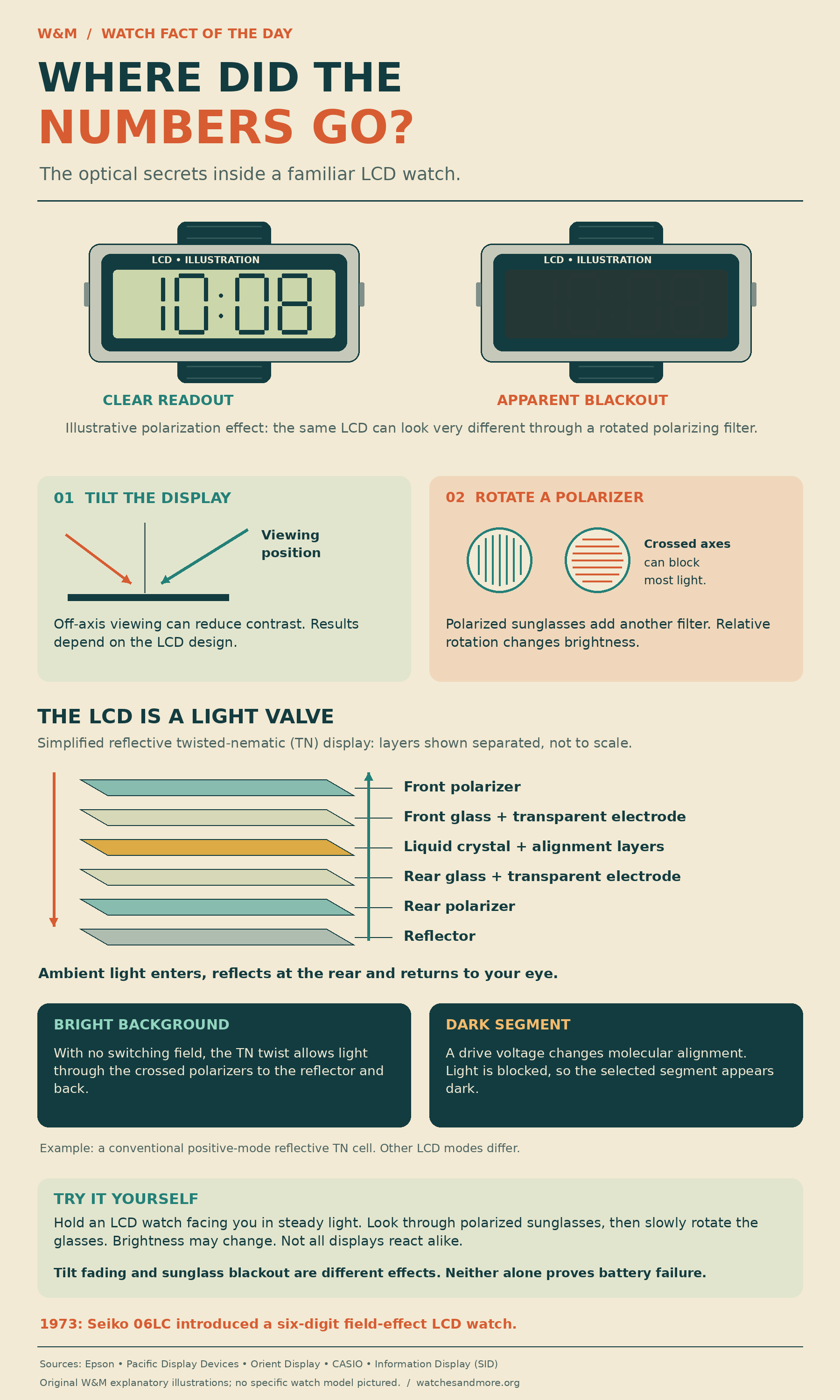
Consider a conventional positive-mode reflective twisted-nematic LCD: the familiar arrangement with dark characters on a light background.
Its functional layers include polarizing films, glass carrying transparent electrodes, alignment layers, liquid crystal and a rear reflector. The electrodes let the circuit select particular areas of the display.
In the unswitched state, the liquid crystal’s twisted alignment allows light to pass through the crossed polarizers and reach the reflector. Apply the appropriate drive voltage to a segment and the molecular alignment changes; light is blocked and that segment looks dark. Remove the switching field and it can return to the bright state. [Pacific Display Devices: operation]
No black ink is being pumped into the numbers. Their appearance changes because selected areas handle light differently. This is a simplified example; other LCD modes and optical stacks behave differently.
↗️ Effect One: Why Tilting the Watch Changes Contrast
An LCD’s appearance depends on the direction from which you look through its optical layers. Move away from a favorable viewing position and the difference between dark segments and their background can shrink.
Display manufacturers distinguish viewing direction—the position offering the best appearance—from the range of angles over which contrast remains acceptable. Some panels are deliberately optimized for a direction offset from straight-on.
Specifications may describe a “6 o’clock” or “12 o’clock” viewing direction. Those labels describe viewing geometry, not the time shown on the screen. The usable range depends on the panel’s construction and drive characteristics; there is no single magic angle for all digital watches. [Pacific Display Devices: viewing angles]
CASIO makes the practical point directly in its Module 3595 precautions: figures can be difficult to read when viewed from an angle. [CASIO]
🕶️ Effect Two: Your Sunglasses Join the Optical System
Many LCDs deliver linearly polarized light. Polarized sunglasses introduce another filter between the screen and your eyes.
Depending on the relative orientation of those filters, the glasses can pass much of that light or block most of it. Rotate the glasses relative to the display and the screen may brighten, dim or appear nearly black.
Display engineer Benjamin Medvitz describes this problem in Information Display, including optical treatments that help some displays remain readable through polarized glasses. That matters here: not every LCD will black out in the same orientation—or black out at all. [Information Display]
A sunglass blackout changes what reaches your eyes. It does not, by itself, show that the watch has stopped keeping time.
🧪 Try a Little Wristwatch Science
- Place an LCD watch facing you in steady, comfortable lighting.
- Look through a pair of polarized sunglasses held in front of your eyes.
- Keep the watch’s viewing position steady and slowly rotate the glasses.
- Then remove the glasses and tilt the watch to compare the separate viewing-angle effect.
Results vary with the display and lenses. The point is to change one thing at a time: filter orientation first, viewing direction second.
📟 A 1973 Breakthrough: Six Digits, Always There
The optical trick has an important place in watch history.
In October 1973, Suwa Seikosha—now Epson—released the Seiko Quartz LC V.F.A. 06LC. Epson identifies it as the first digital wristwatch with a six-digit field-effect LCD, continuously showing hours, minutes and seconds.
That is a specific milestone, rather than a claim that it was the first watch of every possible LCD type. Its built-in lamp also made the numbers readable in darkness. [Epson: 06LC milestone]
Epson’s development account describes choosing field-effect liquid crystal for visibility and low power consumption. Unlike an analog quartz watch, the fully electronic design sent signals to the display without a stepping motor to move hands. [Epson: technology]
The revolution wasn’t only putting numbers on a wrist. It was making them practical to leave on display.
🔋 When Fading Deserves a Closer Look
A screen that darkens only through rotated polarized glasses tells a different story from one that stays faint under normal viewing conditions.
Temperature and battery condition can also affect readability. CASIO’s Module 3595 guide lists dim or blank display contents among possible low-battery indications, and notes that temperature extremes can make its LCD difficult to read. Those cautions apply to that product; check your own watch’s manual for its limits and service guidance. [CASIO precautions]
Don’t diagnose every faded display as “just polarization.” Persistent problems deserve investigation.
⭐ Why It Matters
Digital readability is a design achievement. It involves the display, lighting, viewing position and even what you’re wearing over your eyes.
Once you understand that relationship, a simple wrist turn becomes a small experiment. You can distinguish an optical effect from a symptom that needs attention—and appreciate the engineering behind an everyday object.
❤️ The W&M Take: A Little Magic, Explained
We love watches that hide a clever story in plain sight. This one practically hides the time itself.
There’s no need for a tourbillon or a diamond-covered case to find something fascinating. A familiar LCD and a pair of sunglasses will do.
The numbers may seem to disappear. The science is right there on your wrist.
Sources & Further Reading
- Epson: Six-Digit LCD Digital Watch — development and optical operation
- Epson: Seiko Quartz LC V.F.A. 06LC — October 1973 milestone
- Pacific Display Devices: Basics of LCD Operation
- Pacific Display Devices: LCD Viewing Angles
- Orient Display: What Is an LCD and How It Works
- Crystalfontz: Reflective LCD Displays
- Benjamin Medvitz: Challenges for Outdoor Digital Displays, Information Display, May 2016 — polarization section
- CASIO: Module 3595 Operating Precautions — LCD, temperature and low battery power
Disclaimer: Every effort has been made to keep these watch facts accurate, but the world of horology is full of myths, disputed stories, and fascinating trivia. Consider these facts a starting point for discovery rather than the final word. If you have corrections or additional insights, let us know—we’re always happy to keep the record ticking in the right direction.
Read Next
- 32,768 Vibrations, One Tiny Tick: How a Quartz Watch Moves Its Hands
- Hamilton Pulsar P1: The 1972 LED Time Computer
- 1980s LCD Game Watches: An Arcade on Your Wrist
Watches And More · Watch Fact Archive · Companion site
Have you ever watched your digital display vanish through sunglasses? Try the rotation test and tell us what happens.
Discover more from WatchesAndMoreCO
Subscribe to get the latest posts sent to your email.


